Main developments in Competition Law and Policy for 2024 – Ukraine
2024 marked the third year in which the Antimonopoly Committee of Ukraine (AMCU) exercised its statutory powers amid the challenges of the full-scale war. Yet, as of 2025, the regulator has demonstrated remarkable agility, remaining fully operational – reviewing merger control notifications, commencing investigations, issuing decisions, as well as dedicating significant efforts to aligning Ukrainian competition law with that of the European Union (EU).
In this blog post, we provide a summary of the year’s key developments. We start with fine statistics, enforcement trends, and highlight priority sectors targeted. We also review merger control activity. We examine enforcement in areas like bid rigging and unfair competition. We also highlight the first ever application of the leniency process. Finally, we summarize the AMCU’s efforts on state aid control and competition laws reform. Finally, we outline the AMCU’s enforcement priorities and provide an outlook for 2025.
Fine Statistics
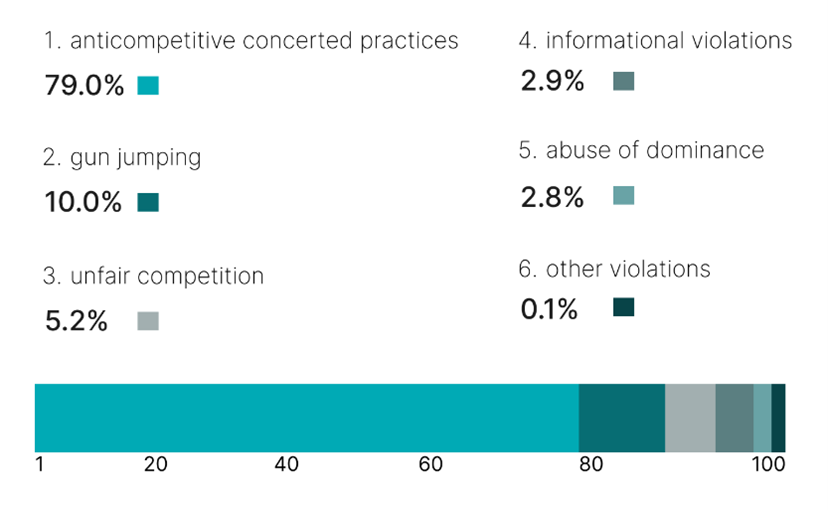
Throughout 2024, the regulator issued 1,146 decisions on violations of Ukrainian competition law, imposing fines totaling just over UAH 1 bln. (approx. (approx. Nearly 90% of the UAH 1 billion fines imposed in 2024 by the regulator were due to two types violations: anticompetitive coordinated practices and gun jumping. The bid rigging was responsible for 100% of all fines for anticompetitive concerted practice. The AMCU also investigated 46 gun-jumping incidents, which accounted for 10% of the total fines. Violations related to unfair competition, informational violations, and abuse of dominance accounted for 5.2%, 2.9%, and 2.8% of the total fines, respectively.
Figure 1. Breakdown of the AMCU fines by Type of Violation
Sectors Targeted by the AMCU
Throughout 2024, the regulator enforced Ukrainian competition law across a broad range of industries, namely:

Figure 2. Sectors at the AMCU’s Spotlight in 2024
Merger Control
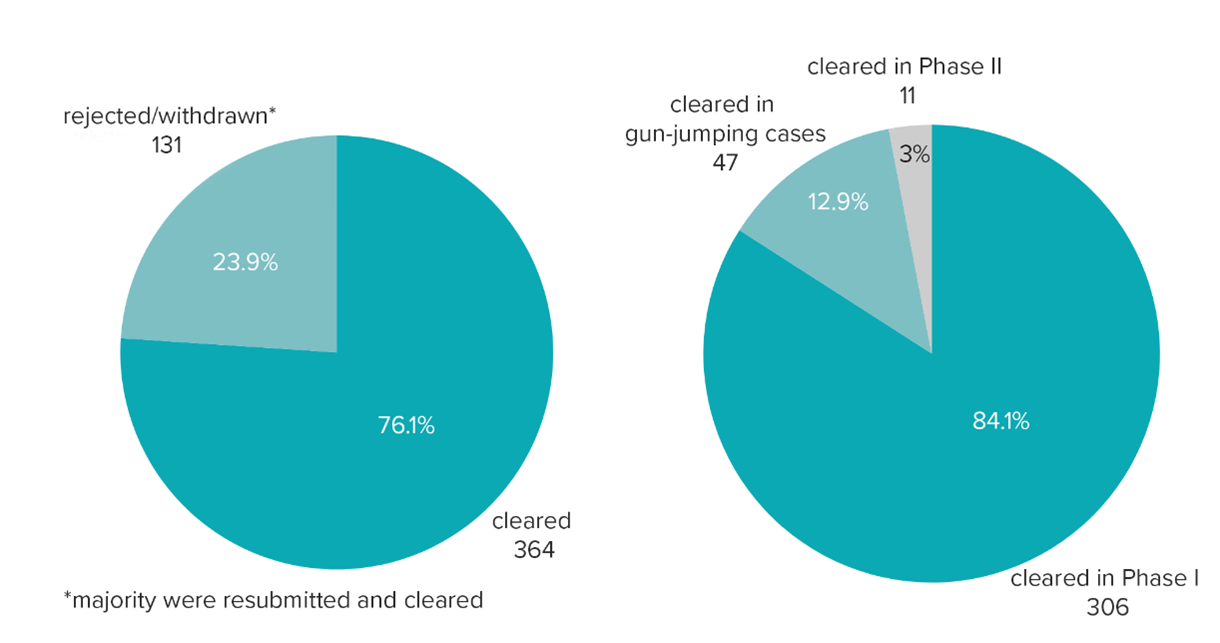
The AMCU was busy with merger control reviews in 2024, having reviewed 496 notifications, of which:
- 364 were processed and resulted in merger clearances;
- 131 were either rejected due to non-compliance with formal requirements or withdrawn by the parties on their own initiative. The parties resubmitted the rejected notifications, resulting in the approval of 364 mergers. The AMCU identified competition concerns in 11 cases. These were cleared in Phase II after an in-depth AMCU review. Four of these cases were subject to remedies. The remaining 47 clearances were issued in gun-jumping cases, where transactions were completed without prior AMCU’s clearance, but the parties voluntarily submitted their filings to the regulator post-closing.[1]Also, in 2024, the AMCU issued 51 preliminary conclusions on mergers. These are issued in response to specific notifications and reflect the AMCU’s initial assessment of whether a transaction requires merger clearance and whether such clearance is likely to be granted.
- Figure 3.
2024 Merger Control Statistics
Notable MergersThe largest transactions by value cleared in Phase I by the AMCU in 2024 included:
$8.5 billion merger of Reliance Industries’ and Walt Disney’s Indian media assets;
$4 billion acquisition of Broadcom’s End-User Computing Division by KKR;
$3.6 billion merger of Berry Global’s Health, Hygiene and Specialties Global Nonwovens and Films business with Glatfelter.
- Out of deals having appreciable nexus in Ukraine, the following are worth mentioning:
- Merger of Bunge and Viterra
- . The AMCU focused its assessment on two markets, namely agricultural products and vegetable oil transshipment at the Mykolaiv Port. The AMCU concluded, in relation to the first market that the combined market shares of the parties were moderate and that the market was highly competitive. In the second market, regulators noted that the port of Mykolaiv had lost its importance since the start of the full-scale conflict in Ukraine in February of 2022. The AMCU concluded that the transaction would not result in monopolization or a restriction of domestic competition and, therefore, granted the clearance. The AMCU concluded that the transaction would not result in monopolization or a restriction of domestic competition and, therefore, granted the clearance.
Acquisition by MSC of Hamburger Hafen und Logistik AG and the Port of Hamburg.
- The AMCU concluded that the transaction could adversely affect competition in the container terminal of the Odesa seaport. The regulator approved the transaction, but imposed certain behavioral remedies on the buyer to mitigate this risk. These included an obligation to not unjustifiably limit third-party access the container terminal services or terminal’s infrastructure. Access must be granted on fair market terms and with at least 30% of the terminal’s annual available design capacity allocated accordingly.Acquisition by CRH of Dyckerhoff Cement Ukraine.
- The parties were close competitors with high market shares in the Ukrainian market for gray Portland cement. To prevent the monopolization of the market, the transaction was cleared subject to certain structural remedies, including:
(1) the divestiture of 25-28% of shares in Dyckerhoff Cement Ukraine (Dyckerhoff), along with certain veto rights, to an independent third party; (2) the appointment of only independent executives at Dyckerhoff; (3) the prohibition to unjustifiably refuse to supply cement to third parties, as well as the obligation to maintain existing production capacities; (4) the application of market-based pricing and fair contract terms to all cement buyers; (5) the prohibition to unjustifiably restrict third-party access to the cement market; and (6) the prohibition on clinker exports that would prevent fulfillment of third-party cement orders. - Gun Jumping
Local Transactions
In 2024, the AMCU imposed fines totaling UAH 101.5 mln. (approx. The fines for gun-jumping violations are approximately EUR 2.3 million. Gun-jumping violations. More than a half of that amount was imposed in the following local transactions:
UAH 37.3 mln. (approx. (approx. Fine for the acquisition by PJSC “Kyiv Cardboard and Paper Mill” of LLC “Autospetstrans–Kyiv Cardboard and Paper Mill,” which took place in 2017;
UAH 21.33 mln. (approx. (approx. The regulator determined that the buyers of these transactions (PJSC Kyiv Cardboard and Paper Mill and LLC “Pulp Mill print”) were members of the same corporate group. Repeated violations by entities within the same group may be considered an aggravating factor by the regulator and could contribute to the imposition of higher fines.
Foreign-To-Foreign Transactions
- Additionally, in 2024, the AMCU imposed fines for closing foreign-to-foreign transactions without the regulator’s clearance:
- UAH 4.5 mln. ( EUR 0.11 million.) fine for the creation of a joint venture between Electricite de France, Nebras Power, Sojitz Corporation and Kyuden International Corporation;
UAH 2.5 mln. ( EUR 0.06 million.) Sika fined for acquiring control of MBCC by Sika;
UAH 0,47 mln. ( EUR 0.01 million.) Fine for the acquisition of control by YILFERT Holding over Rosier SA. ( EUR 0.001 million.)
- Bid Rigging
- In 2024, the AMCU continued its traditional focus on identifying bid-rigging violations – i.e., the distortion of results of bids, auctions and public procurements – which constitute one type anticompetitive concerted actions under Ukrainian competition law.
- Bid Rigging
- In 2020, the AMCU will continue its tradition of identifying bid-rigging, i.e. the distortion of the results of auctions, public procurements, and tenders. This is one of the types anticompetitive concerted action under Ukrainian competition laws. The regulator issued 2,012 decisions last year related to anticompetitive coordinated actions, with 100% of them being bid-rigging. The highest fine for bid rigging was UAH 106 million. (approx. (approx. It is worth noting that the AMCU has developed a strong expertise in dealing with this type of violation. In Ukraine, bid-rigging is a violation per se, so the regulator does not need to prove that it has a negative impact on domestic competition. Furthermore, fines for bid rigging may reach up to 10% of the annual turnover per violation; however, the most adverse consequence is not the fine, but rather the prohibition from participating in public procurements for the next three years.[2]
Unfair Competition
In 2024, the AMCU identified 58 violations of the Law of Ukraine “On Protection Against Unfair Competition” (
Unfair Competition Law
), with total fines amounting to UAH 53.3 mln. (approx. (approx. The AMCU imposed the highest fine for unfair competition in Ukraine last year of UAH 17.7 mln. (approx. (approx. Traditionally, the most frequent violation of the Unfair Competition Law in the country has been the dissemination of misleading information.
In 2024, the AMCU focused on identifying the dissemination of misleading information across three markets: mineral waters, dietary supplements, and cosmetic products. It is worth noting that the threshold for proving misleading information in Ukraine is relatively low, as the applicable legal test in Ukraine is based on the perspective of an average, unskilled consumer – someone who is presumed not to verify the accuracy of commercial claims and who relies primarily on their overall first impression.
Informational ViolationsIn 2024, the AMCU continued its active efforts to combat so-called informational violations – i.e., providing false, inaccurate, or incomplete information to the regulator in response to its request, or failing to submit the requested information altogether. The regulator reviewed 312 cases of informational violations in 2024, with the most common being the failure to submit the requested information.
Nord Stream 2 Project-Related Case
The case stemmed from the AMCU’s investigation into alleged anti-competitive agreements related to the Nord Stream 2 project (
Project
). AMCU began an investigation in 2021 after suspecting that Project participants had violated the law by gun-jumping. They also failed to obtain the regulator’s prior approval for concerted practices. As part of the investigation, the AMCU sent the requests to the Ukrainian subsidiaries of: (1) Engie Energy Management Holding Switzerland AG (
Engie
), (2) Shell Exploration and Production (LXXI) B.V. (Shell), and (3) Wintershall Nederland Transport and Trading B.V. (Wintershall) requesting to confirm or deny conclusion of any agreements related to the Project.According to the AMCU, none of the entities submitted information to the regulator, preventing the latter from exercising its discretionary powers – in case at hand, determining whether the participants in the Project were required to obtain prior clearance. The AMCU fined the Ukrainian subsidiaries of Engie and Shell. Shell’s Ukrainian subsidiary was fined UAH 43 million. (approx. (approx. The AMCU imposed the largest fine for an informational infraction ever. The AMCU’s decision was challenged by all three entities in Ukrainian courts. The main question in this case was if Ukrainian entities belonging to foreign corporate group can be held responsible for not providing the regulator with requested information that is held by another entity within the corporate group. The Supreme Court ruled holding a Ukrainian entity responsible for not providing information that is held by a foreign affiliate violates the principle of fairness when it comes to legal liability. Furthermore, it emphasized that corporate affiliation alone does not justify extending the AMCU’s enforcement powers beyond Ukraine’s jurisdiction. AMCU Started Targeting Digital MarketsJumping ahead, digital markets have been identified as the AMCU’s top enforcement priority for 2025. The regulator started moving in this direction in 2024 when it issued recommendations to two tech companies that operated in different areas of digital economy. AMCU expressed concern that users were charged commission fees up to 10% and had no access to other payment service providers that offered more competitive rates. To address these concerns, the regulator issued recommendations to the municipal entity administering the app to promote competition by enabling the integration of additional PSPs on transparent, clear, and non-discriminatory terms.
BlaBlaCar
Later in the year, the AMCU turned its attention to BlaBlaCar, identifying the platform as likely dominant in the narrowly defined market of “carpooling services via online platforms in Ukraine”, citing its market leadership and lack of substantial competition from rivals. The regulator claimed that BlaBlaCar charged unjustified fees to passengers, and had inconsistent refund policies for passengers who canceled rides. The AMCU recommended the company adopt a transparent method for fee calculation and implement an equitable and non-discriminatory policy of refund.
–
Legislative Developments & EU Integration
Last Year, the AMCU continued to actively support Ukraine’s EU Integration efforts. In the second phase, the regulator developed legislation proposals to strengthen its institutional capacity and provide more effective tools for enforcing the competition law. Notably, the proposals introduce administrative liability for companies and government officials who obstruct dawn raids, fail to submit requested information to the regulator, or ignore official summonses to appear and provide explanations.
On the international front, the AMCU took significant steps toward obtaining associate membership in the OECD Competition Committee, further aligning Ukraine’s competition framework with global best practices, including implementation of the OECD Recommendations on Competitive Neutrality. The regulator worked closely with the European Commission to ensure that Ukrainian legislation was aligned with EU law. This included bilateral meetings held as part of an official screening process. Although leniency provisions have been part of Ukraine’s competition law since the year 2002, their effectiveness has been hindered for years by a lack of clear procedure guidance. A significant shift occurred with the entry into force of competition law amendments on 1 January 2024, accompanied by the adoption of the respective procedure by the AMCU.
Ukraine’s updated leniency procedure brings greater clarity and alignment with EU standards. The first applicant is granted immunity from all liability, while the subsequent applicants can receive fine reductions up to 50%, 30 %, or 20 %. Applications can be submitted even after an investigation has started, as long as they are filed before the AMCU issues its preliminary conclusions.
In December 2024, the AMCU applied the updated leniency procedure in a bid-rigging case involving two public procurements. One company was granted full immunity for cooperating fully, providing key evidence, and providing information to the regulator. The second company that did not cooperate was fined 2% of its annual turnover (the maximum statutory penalty of up to ten percent) for each of the bid-rigging violations it committed. The regulatory framework, effective from 2 August 2017, is based on the law of Ukraine “On State Aid to Undertakings” (
State Aid Law
) and secondary legislation.
Following the full-scale invasion by Russia, Ukraine introduced martial law, leading to a temporary suspension of state aid control, effective from March 2022. Since then, state-aid grantors are exempt from notifying the AMCU about new or amended measures. These measures are automatically deemed to be compatible with domestic competition laws. In accordance with its obligations under EU-Ukraine Association Agreements, the AMCU carried out a partial inventory and compiled a listing of potential state assistance measures that require compliance with the State Aid Law. The grantors are required to align their schemes with the law, including its compatibility criteria. In its 2024 report the AMCU highlighted that the following markets and sectors were its top enforcement priorities in 2025:
Figure 4
AMCU’s Top Priorities For 2025
The AMCU highlighted in its report the fact that identifying bid rigging violations will remain a priority in the coming year in the following sectors: defense, healthcare and construction. Another key priority for the AMCU in 2025 will be enhancing its institutional capacity, including harmonizing Ukrainian competition law with EU standards, continuing cooperation with the OECD, and further strengthening the AMCU’s powers in bid-rigging investigations.
Outlook for 2025
Despite the ongoing challenges of wartime, we expect the AMCU to remain fully operational and increasingly active in 2025. The regulator will likely issue more decisions, impose larger fines, and launch new investigations and sector inquires. This number has remained constant between 450 and 500 over the last five years. Given the AMCU’s growing focus on identifying gun-jumping violations, we strongly recommend that foreign counsel assess carefully whether a transaction is notifiable and ensure timely notification when required.
Finally, we expect the AMCU’s increasing interest in digital markets to translate into more assertive enforcement. The regulator has made it clear that digital platforms will be its top priority for enforcement in 2025. As a result, the statistics may be distorted and the actual number of distinct deals could be lower than the number of filings suggests. The statistics could be distorted and the actual number may be lower than what the filings suggest.