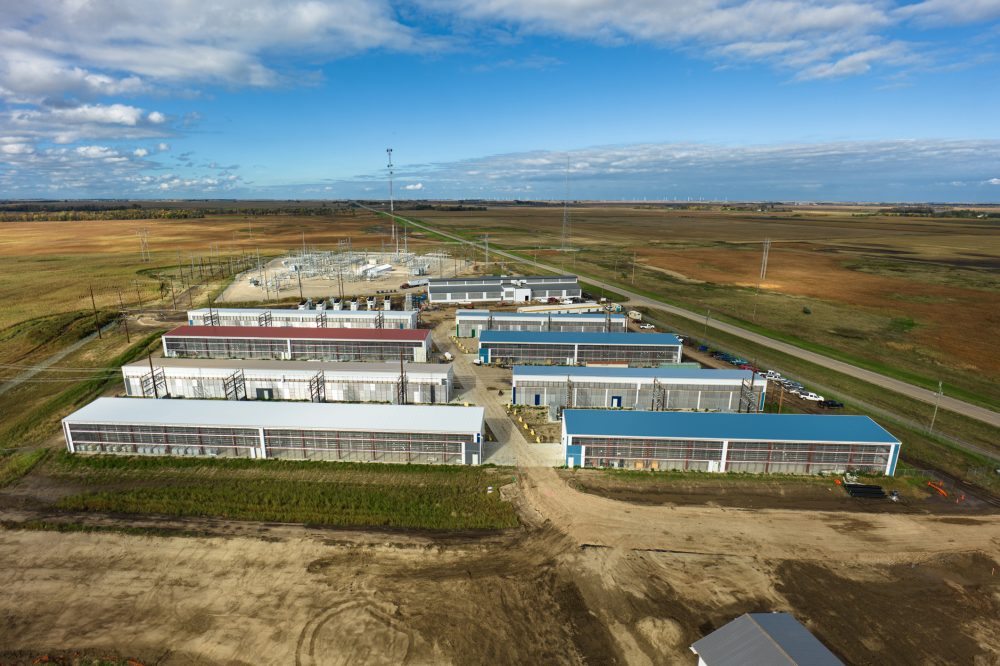
Gravel2Gavel Construction & Real Estate Law blog — April 29, 2025
The increasing demand for digital infrastructure coupled with the volatility of cryptocurrency demand has led to a significant interest in converting building improvements housing crypto-mining farms into high-capacity modern data centers. Crypto mines and high-capacity data centers have some common elements, such as a large footprint, the need for cooling and power, but they serve different purposes. Their operational models, regulatory requirements, and technical requirements are also different. Below are some key distinctions between the two, as well as issues developers should anticipate, when designing and constructing either type of facility, or considering a crypto farm-to-data center conversion.
Built for Different Purposes
Crypto mines and data centers share a fundamental requirement–both demand enormous computational power, resulting in the need for massive amounts of power and cooling. The facilities are designed and operated differently due to their distinct operational goals. Despite their common infrastructure backbone, their distinct purposes result in differing technical and architectural configurations.
It is useful to review the basics. A crypto mine is an infrastructure that solves complex mathematical problems to secure digital currency, especially for cryptocurrencies similar to Bitcoin. The “miners” are rewarded with new cryptocurrency in return for their work. In return for this work, the “miners” are rewarded with new cryptocurrency.
The Greek poet Archilochus wrote, “the fox knows many things, but the hedgehog knows one big thing.” Crypto mining facilities are hedgehogs, optimized for one task and one task only: performing vast numbers of computations, often through proof-of-work algorithms, to validate transactions on a blockchain. These operations are powered by ASICs or high-performance graphics processor units (GPUs), which run nonstop in order to maximize hash rates and, by extension potential earnings. Data centers are often likened to a complex of warehouses that house computers, equipment, and other multipurpose digital ecologies designed to store and manage large volumes of digital information. Their design and complexity may vary depending on operator functions and support needs, but they all require strong telecommunication capabilities to interact with the outside world without lag, and uber-redundancy to maintain service reliability and keep systems running 24/7. While their design and complexity may vary depending on operator functions and support needs, most require strong telecommunication capability to interact with the outside world with no lag, and uber-redundancy to maintain service reliability and keep systems running 24/7.
Key Operational Differences
The most fundamental operational distinction between crypto mines and data centers rests in how they are expected to perform under pressure. Crypto operations are designed to tolerate downtime. If a machine fails, they can adjust their network without major disruption. Crypto mines can take advantage of power price differences by operating at optimal times of day or in response to other market signals. Crypto mines are able to take advantage of the differences in power prices by operating during optimal times of the day or responding to other market signals.
Data centres, on other hand, tend to be built for near-continuous availability. Any interruption can lead to financial losses, data corruption, negative customer impact and reputational damage. These facilities rely on multiple backup systems, dual power feeds, failover networking, and strict monitoring to ensure performance and availability.
Network speed is another point of distinction. Crypto mines don’t require high-speed bandwidth since they only deal in small bits of transactional data. In contrast, data centers are constantly sending and receiving large amounts of information between users and systems, so they require fast, reliable internet through fiber-optic and satellite telecommunications.
Another key difference is how intensively each facility works its hardware. Crypto miners run their machines, such as ASICs and graphics processors, at full power, all day long, every day. They do not make any effort to balance out the load. This heavy usage can wear out hardware faster. Data centers, on the other hand, take a more measured approach to extend the life of their cutting-edge hardware.
Shared Infrastructure and Design
Despite these differences, crypto mines and data centers share a common need for underlying infrastructure. That commonality is a large part of the reason that potential conversions are gaining traction.
Both facility types rely on massive computational power–whether through ASICs, GPUs or CPUs–to deliver nonstop performance. As a result, both require large-scale, efficient power delivery systems and advanced thermal management to keep hardware from overheating.
In addition, crypto mines and data centers often share similar physical layouts, starting with a large warehouse-type space. These facilities include raised floors for cabling or dedicated conduits, reinforced structures that can accommodate heavy equipment and secure access points that protect valuable hardware. Infrastructure will be subject to the same building codes, industry standards, and ANSI/TIA 942, as well as APC No. 92. These basic shared design elements make conversions feasible at a structural level.
Technical Challenges in Conversions
Because of their shared structural infrastructure, converting a crypto mine into a data center–or vice versa–has become an appealing potential option to developers as a cost-efficient reuse of an existing facility. Developers must be aware of the technical challenges that can affect their bottom line. Below are several to consider.
Power Redundancy
In general, while crypto mines are typically optimized for maximum computation density with less of an emphasis on redundancy and resiliency, resiliency is perhaps the primary consideration when building and operating data centers. Converting a crypto mining facility to meet data center standards requires significant upgrades to power distribution units and the addition of uninterruptible power supplies (UPS) and backup generators to ensure reliability and compliance with data center uptime standards.
Cooling Systems
Crypto mining rigs generally operate under sustained maximum load to produce concentrated heat, which often exceeds the load legacy data center HVAC systems were designed to withstand. Conversion to a data center will likely require upgrades from basic or immersion cooling systems to precision computer room air conditioning/computer room air handling (CRAC/CRAH) units. Standard data center server racks cannot accommodate ASIC miners and high-performance GPUs due to their form factor or thermal output. Operators must also account for the different power delivery profiles of mining hardware, which often draw higher amperage at lower voltages than traditional information technology equipment.
Network Infrastructure
In either direction, reconfiguring network infrastructure to fit the requirements of each specific use is another key challenge. Crypto mines are reliant on minimal network bandwidth and lack the robust switching equipment and routing equipment required for enterprise data workloads. Conversion to a datacenter will require the installation of high-speed fibre, routers, and redundant connections. Conversely, existing data center fiber and bandwidth capacity may remain underutilized in a mining operation, leading to a potential stranded investment.
Security Requirements
Security requirements can also shift when converting a crypto mine to a data center. Crypto mines place a higher priority on physical security in order to prevent thefts of valuable mining equipment. Data centers require physical and cybersecurity protocols. These include biometric access controls and 24/7 surveillance, audit logs to ensure compliance, multi-factor identification, and compliance with frameworks like ISO 27001 or SOC 2 The co-location and leasing models of data centers require physical and system segmentation, as well as segregation between customer assets and utilities that serve those assets. Noise Control
When considering a potential conversion of a crypto facility, it is important to consider noise control. This is especially true depending on the location. Crypto mines are often located in industrial or remote locations and generate a lot of noise, mainly from ASICs, high speed fans, and dense clusters mining rigs. Noise abatement is not a priority for these crypto mines. Data centers, particularly the edge data centres, are often located near residential or commercial zones. These facilities are subject to more stringent noise regulations and community impact requirements. Conversion may necessitate installation of sound dampening infrastructure, such as soundproofing or upgraded HVAC systems, to comply with local ordinances and mitigate operational disruptions.
The bottom line? Converting a crypto mine to a datacenter, or vice-versa, can be a viable way to repurpose a facility that is no longer being used. It is a complex process. The Anatomy of a data center
U.S. Department of Energy Pursues Data Centers in Federal Lands