Class action question turns into procedural dispute
Another Supreme Court day and, fitting for the way the term has gone so far, another case which is pretty obvious does not belong in front of the court. The justices granted a review in Laboratory Corporation of America Holdings V. Davis in order to decide if a district court could certify a group action that included claimants who had not suffered any cognizable injuries. In this case, for instance, a group blind individuals sued Labcorp after it installed automated check in kiosks in its facilities during the COVID-19 period. The class argues that the kiosks are discriminatory against the blind. The parties spent much time in district court arguing over the appropriate bounds of the group. The court initially defined a class which excluded those who didn’t know about the kiosk or didn’t want to use it, based on the idea that they weren’t injured. Later, the district court modified the definition to include everybody who came into a clinic, whether they did or did not want to use the kiosk.
Labcorp’s arguments in the court challenge that second definition, but the problem is that it only appealed the first definition, which is strictly limited to those who can claim an injury from the presence of the kiosks. The U.S. Court of Appeals, 9th Circuit, ruled that Labcorp had no jurisdiction to review the second definition because it did not appeal that definition. So now the justices have a case with briefs challenging the propriety of a definition that the defendant never appealed.
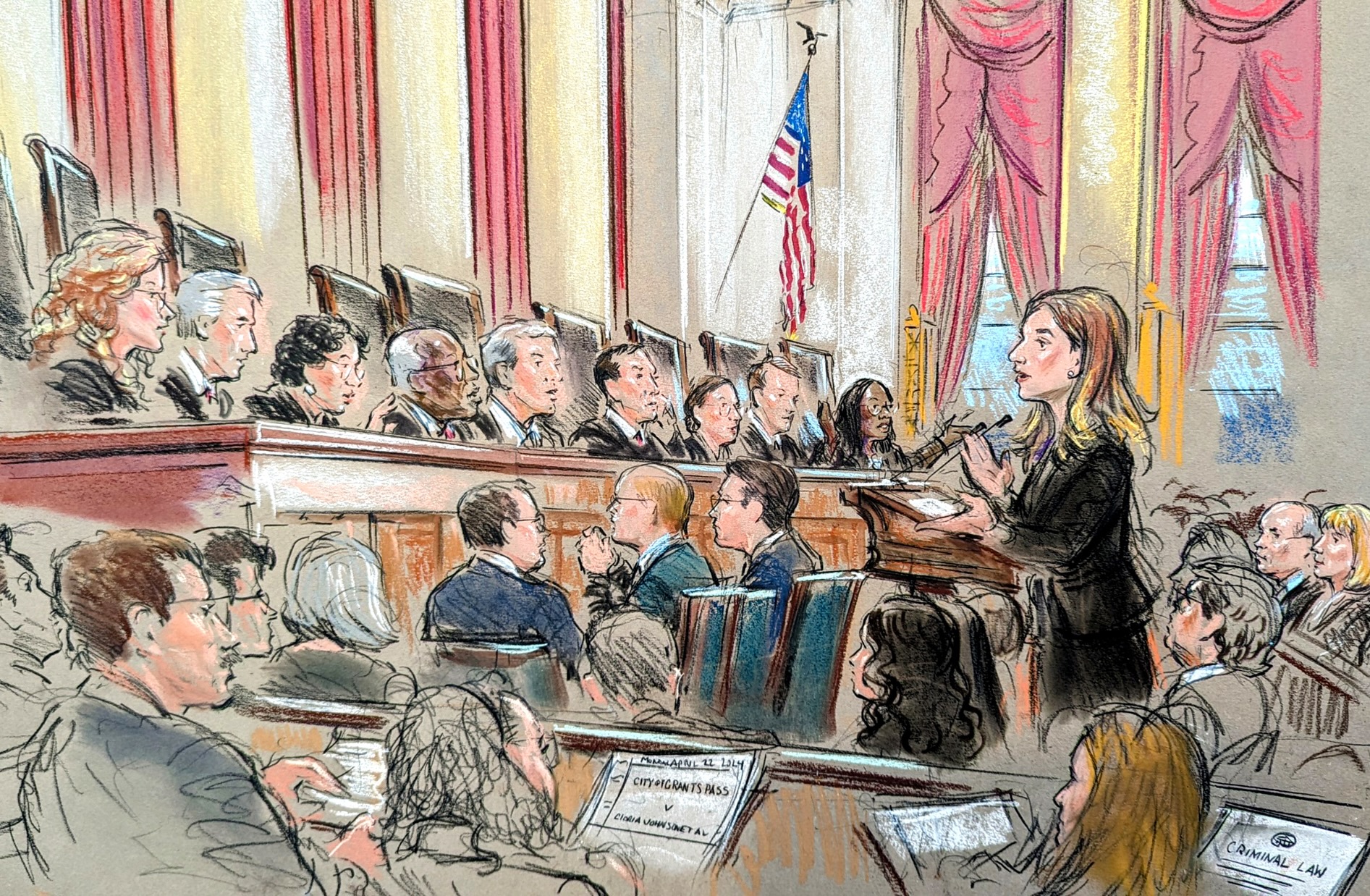
Predictably, a large share of the argument was about what the justices should do about that. For the most part, the sentiment (expressed repeatedly by Justices Amy Coney Barrett and Sonia Sotomayor) was that the court has no reason to address the second definition and that it should send the case back to the lower courts to let them consider whether there is any way for Labcorp still to challenge that definition.
To the extent the justices addressed the question on which they granted review, the justices appeared skeptical of Labcorp’s position. Justices Elena Kagan and Ketanji brown Jackson were the leaders in this regard, followed by Neil Gorsuch and Sotomayor. Labcorp contended that the members of the class necessarily have to share the same injury to be in the class, but the justices seemed to think that class definitions are quite “fluid,” as Sotomayor emphasized.
The group could not see any reason why the question of precisely who was injured needs to be settled up front. According to them, the only rule that is required by the rules is for the court to find a method to separate the “wheat” from the “chaff”, or the injured from those who are not. This will be done before the court awards damages.
Sotomayor recalled her time as a judge and said that class definitions are “always changing” and that it isn’t until the judgment has been entered that one can determine who was injured or not. There are some common questions. The named plaintiffs tend to be typical, and common issues are predominant.”
When Sopan Joshuai, representing government, argued the problem was that the class didn’t have “commonality,” unless plaintiffs shared the same injury, Gorsuch, Kagan, and Sopan Joshi both objected vehemently. Gorsuch interrupted: “Hold it. I thought it meant that one issue had to be common and that this had to be dominant. …. There must be a question that dominates others. There has to be a common question that predominates over others.”
Apparently bemused by his discussion of commonality, Kagan asked Joshi to look back at the past 70 years of the court’s class action cases. “
It strikes me that, if you look back at all the class actions that have been certified up to that point, there will always be people who, for idiosyncratic reason, don’t share a common injury, or don’t have standing. And all that has never been seen as the end of the matter,” she said. Kagan said that to do this, “we must explode everything.” So it seems very inconsistent to me with the way class actions have been practiced for many decades.”
That’s not to say that there was no sympathy for Labcorp’s position. Chief Justice John Roberts and Justice Brett Kavanaugh commented on the “elephant in the room” – that the very certification of a class often can force defendants to settle – but they did not suggest any way to avoid the procedural obstacle to reaching the question.[I]Although the justices have shown some interest this year in reaching out to decide the questions to which they devoted an hour of oral argument, this really seems to be one where there is little appetite for finding a way to reach that question. It is hard to imagine a majority that would be willing to find a way past the obvious difficulties when Barrett, Gorsuch and Kagan are among those who are skeptics about the issue.
Posted in Featured, Merits Cases
Cases: Laboratory Corporation of America Holdings v. Davis
Recommended Citation:
Ronald Mann
Class action question turns into procedural dispute ,
SCOTUSblog (Apr. 30, 2025, 5:08 PM),