Book Interview: Gestation, Biotechnology and the Law
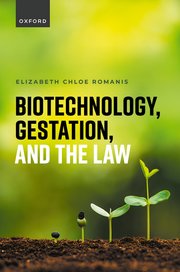
Former Fellow-in Residence Elizabeth Chloe Romanis published her latest book Biotechnology, Gestation and the Law with Oxford University Press. Chloe Romanis is interviewed about the book and its key themes. She spent 2022-2023 at the Edmond and Lily Safra Center for Ethics and the Petrie-Flom Center. Here, we catch up with Chloe to ask her about the book and its key themes.
Petrie-Flom Center: What is Biotechnology, Gestation, and the Law about?
Chloe: Where people experience involuntary childlessness because they cannot, for biological, social, or psychosocial reasons, sustain a pregnancy, they can pursue parenthood through routes that mean other people have undertaken the gestational work, e.g. surrogacy or adoption.
However, these routes do not always meet the procreative needs of individuals because they want to gestate themselves, or because they value genetic relatedness.
Technologies on the horizon — which I call technologies enabling gestation — are exciting because they have the potential to enable new modalities of gestation that better meet the procreative needs of individuals who cannot sustain a pregnancy. These technologies raise important questions in a metaphysical sense about how we procreate and how we relate with procreation. Can you explain the concept of “unsexing” pregnancy? Where is the technology at currently?
The idea for the concept of ‘unsexing pregnancy’ came from thinking about uterus transplantation. Uterus transplants are in the process to transition from being an experimental surgical procedure into a treatment for absolute infertility due to uterine factors. To date, the procedure has only been performed on women who are cis. While it may be some time before UTx is available in this way, it offers the possibility of thinking about pregnancies beyond how we think about sexed roles in procreation — what some bodies can or cannot do. It may take some time before UTx can be used in this way. However, it opens up the possibility of thinking about pregnancy beyond the shackles we have placed on our conceptions of sexed roles and what certain bodies are capable of. Transphobia and structural violence are a major problem for them. This is largely because those who subscribed to a biological essentialist view of’sex,’ often problematically rely on the ability to sustain a pregnant as a way of differentiating between’male and ‘female” bodies. It is important to welcome technologies that demonstrate the fragility of a binary sexing system based on a body’s ability to sustain pregnancy. There are also the additional benefits from the possibilities of ‘unsexing’ that should be taken seriously as provocations: What would the world look like if cis men could, and did, undertake pregnancy?
You refer to “gestation beyond the body.” How could that change reproductive science?
Gestation beyond bodies, or ‘ectogestation’ (gestation facilitated by machine), is a wholly speculative idea in the current state of play. The idea of “gestation beyond the body” or ‘ectogestation’ (gestation facilitated by machine) is a speculative one at this time. These devices are not capable of growing babies from birth to the point of conception. This would be a completely different device and there are many legal and regulatory obstacles (e.g. It’s important to know what technology can’t do and the obstacles that stand in the way of a complete ectogestation. It is important to speculate about the possibilities, their ethical, social, legal, and other challenges. Imagining complete ectogestation and what it could mean and its potential implications can still teach us so much about the nature of gestation, how we treat pregnant people, and contemporary procreative injustices.
Romanis’ book, Biotechnology, Gestation, and the Law, is available here.
You write that pregnancy itself hasn’t been studied much from a legal/ethical/academic perspective. The fetus, on the other hand, has been a major focus. Why do you believe that? Suki Finn says that pregnancy as a state is not often considered worthy of philosophical inquiry. There is a lot of literature on pregnancy-related issues (mostly abortion), yet this is rarely a consideration of the state itself, and is often in some way about the fetus. The fields of academic law and philosophy are dominated by people without experience (or who cannot experience) pregnancy. This influences what is important to think about. In philosophy, growing bodies of work like the phenomenology and metaphysics of pregnancy acknowledge that pregnancy is something we can and should consider more. This insight has been under-utilised in legal scholarship, and there’s a need to also think about gestation, which is distinct from pregnancy. That’s what I tried to do in my book! My thought is that ultimately technologies enabling gestation have some really exciting potential, particularly for those who experience involuntary childlessness related to an inability to gestate, however, this potential is significantly limited unless there is significant social and legal reform to address the biological essentialism at the root of how we think about and regulate procreation.
About the book’s author
Elizabeth Chloe Romanis
was a Fellow-in-Residence at the Edmond and Lily Safra Center for Ethics and the Petrie-Flom Center for 2022-2023. She is an Associate professor of Biolaw at Durham University in the UK. Chloe is a researcher in healthcare law and ethics with a special interest in reproduction (abortion), gestation, pregnancy and birth).