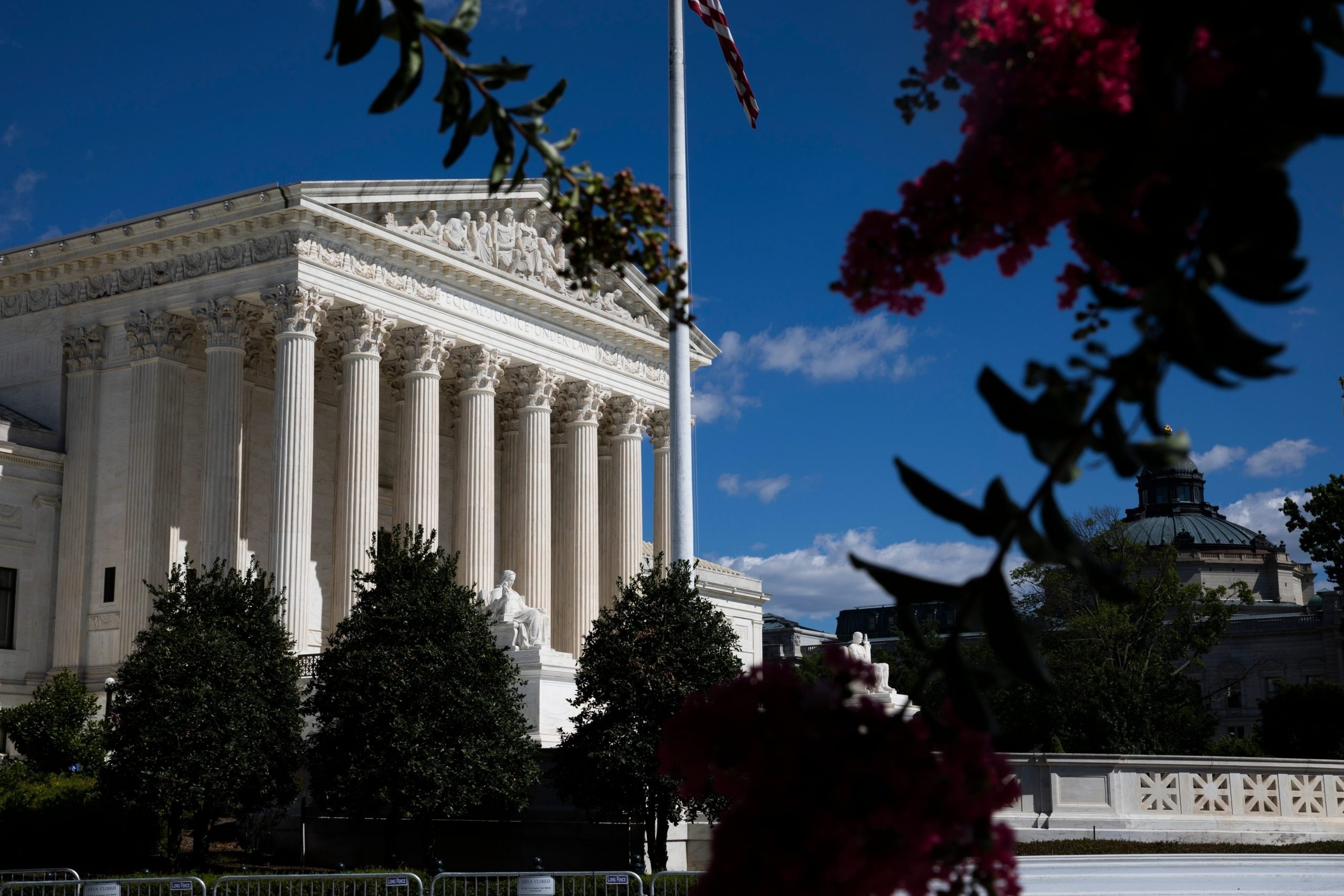
Supreme Court hears Mexico’s lawsuit against U.S. firearm manufacturers
CASE PREVIEW
on Mar 3, 2025
at 3:49 pm
The court will hear Smith & Wesson Brands, Inc. v. Estados Unidos Mexicanos on Tuesday. (Aashish Kiphayet via Shutterstock)
Just two weeks after the Trump administration designated six Mexican cartels as foreign terrorist organizations, Mexico will come to the Supreme Court on Tuesday in its effort to hold U.S. gun makers liable for cartel violence committed with U.S.-made weapons.
Mexico is seeking billions of dollars from seven major U.S. gun makers and one gun wholesaler to recover costs related to gun violence and to stop the marketing and trafficking of illegal guns to Mexico. But the gun makers counter that the lawsuit “challenges how the American firearms industry has openly operated in broad daylight for years.”
Tuesday’s case is the first test before the high court of a federal law enacted in 2005 to protect the gun industry. The law contains a key exception that allows lawsuits if the harm stems from a manufacturer’s violation of U.S. legislation. The government issues less than 50 permits each year and there is only one store in the entire country. Mexico is ranked third in the world for gun-related deaths. In 2021, 69% homicides involved a gun. Mexico contends that as many as 70 to 90% of the guns that police recover at crime scenes in the country were trafficked into Mexico from the United States.
Mexico filed a lawsuit in 2021 in federal court in Massachusetts. Mexico argued that gun makers design and market their weapons as military-styled weapons, knowing they will be attractive to Mexican drug cartels. It also claimed that gun makers used a three-tiered distribution system to facilitate an illegal market in Mexico for their guns, with gun dealers selling to buyers who acted as strawmen for someone who could not legally buy a gun. This led to more than $170 million worth guns being trafficked into Mexico every year. The court ruled that Mexico’s claims were barred under a federal law called the Protection of Lawful Commerce in Arms Act. This was intended to shield the U.S. firearm industry from lawsuits in U.S. Courts for the misuse of weapons by others. The U.S. Court of Appeals 1st Circuit reversed the ruling, allowing the case move forward. The court of appeals held that although the law’s restrictions apply to lawsuits brought abroad by foreign governments, Mexico’s claims fall under an exemption for lawsuits where a gun maker violates federal or State laws “applicable” to the sale or market of firearms. This violation caused the injury that the plaintiff is seeking. The 1st Circuit also stated that the Mexican government incurs direct costs due to the facilitation of gun trafficking by the cartels. These include the cost of hiring more law enforcement personnel, and their training. The gun makers went to the Supreme Court to ask the justices for their opinion. They agreed to do so in October.
In the Supreme Court, the gun makers dismiss Mexico’s suit as targeting their “routine business practices.” They say that the Supreme Court made clear in 2023, in a case seeking to hold Twitter liable for allegedly aiding terrorists through its algorithms, that simply engaging in normal business practices is not enough to make someone an accomplice to a crime, even if they know that the products that they make “may be criminally misused downstream.”
As a general rule, the gun makers continue, a company cannot be held liable for the criminal misuse of a product that it makes or sells because what matters is the direct cause of the plaintiff’s injury – and it is the criminal misuse of the product, rather than its production or sale, that cause the injury.
Here, the gun makers argue, any connection between their own conduct and any injuries suffered by Mexico is too attenuated to hold them liable. Mexico’s theory, they stress, “rests upon a medley of independent criminal acts, spanning an international border”: Gun makers produce the firearms in the United States and sell them to distributors, which then sell them to dealers, “some of whom illegally (or negligently) sell firearms to criminals, some of which are smuggled into Mexico, where a fraction ends up with cartels, who use some to commit violent crimes, finally harming Mexico’s government through increased costs.”
And more broadly, the gun makers warn, allowing Mexico’s lawsuit to go forward could have “serious implications well beyond the firearms industry, affecting every business whose products might be criminally misused downstream.”
Mexico urged the justices to allow the case to proceed for now, noting that the case is still in its early stages. Mexico rejects the gun makers’ claim that Mexico is trying hold them responsible for doing “business” as usual. Here, Mexico writes, its claim is that that the gun manufacturers aided and abetted – that is, helped and encouraged – the violation of gun laws by intentionally supplying and facilitating the illegal sale of guns in large quantities to known gun traffickers for cartels in Mexico.
Mexico also alleges that the gun makers’ conduct caused its injuries. The gun makers broke laws that prohibit sales to straw purchasers, and exporting weapons to Mexico. These laws are meant to prevent criminals gaining access to guns. It was foreseeable that these violations of the law would injure Mexico, the government says.
Allowing this case to move forward would not open the floodgates for liability in other industries, the Mexican government insists. The Mexican government says that other industries can rest easy unless they also knowingly aid unlawful activity on a grand scale. The Mexican government assures the judges that other industries can rest easy, unless they knowingly aid unlawful activities on a large scale.